
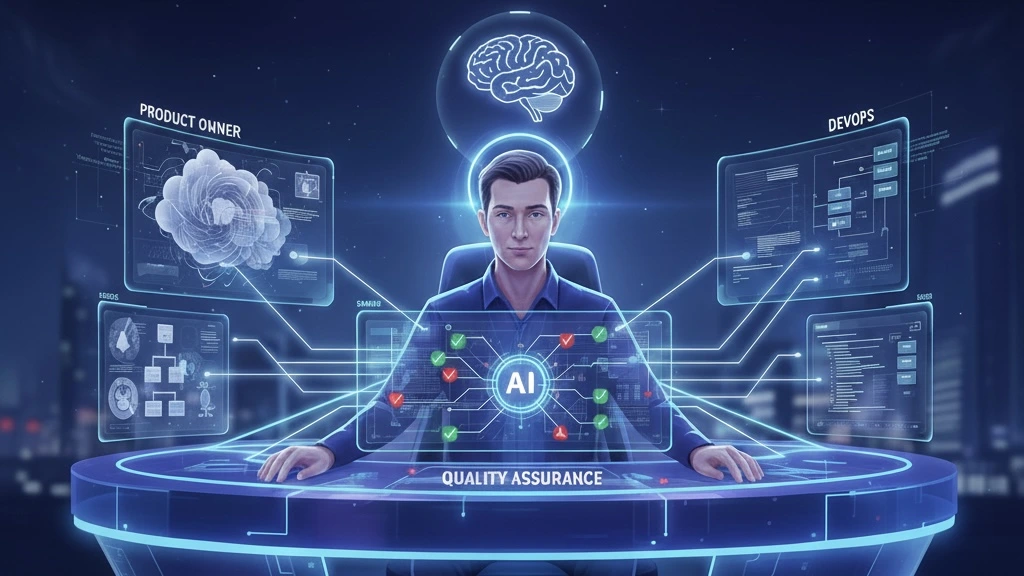
In the traditional software development lifecycle (SDLC), a project moves like a baton in a relay race—passing from the Product Owner (PO) to the Developer, then to the Tester, and finally to the DevOps engineer. For a senior developer, managing all these roles was once a recipe for burnout.
However, the rise of Generative AI and Agentic Workflows has shifted the paradigm. A senior developer can now act as a “force multiplier,” using AI to automate the administrative and repetitive tasks of each role, leaving them to focus on high-level architecture and strategic decision-making.
1. The AI as Product Owner: From Vision to Backlog
The PO’s job is to translate “business speak” into actionable technical requirements. This often involves endless hours of drafting user stories and acceptance criteria.
• Requirement Synthesis: Instead of manual drafting, a senior dev can feed raw meeting transcripts (from tools like Fireflies.ai or Otter) into an LLM to generate a structured Lean Canvas or a prioritized backlog.
• User Story Generation: Tools like Jira Product Discovery or ClickUp AI can take a single-sentence feature idea and expand it into a full user story with detailed Acceptance Criteria (AC).
• Strategic Prioritization: AI can analyze market trends or user feedback data to suggest which features will provide the highest ROI, allowing the dev to make data-backed “Go/No-Go” decisions.
2. The AI as Tester: Shifting Quality to the Left
Testing is usually the bottleneck. A senior developer using AI can implement a “Shift-Left” strategy, where testing happens simultaneously with coding.
• Autonomous Test Generation: Tools like Qodo (formerly Codium) or Testim analyze the code context to generate unit and integration tests instantly.
• Self-Healing Tests: One of the biggest pains in QA is maintaining brittle UI tests. AI-powered testing platforms can “heal” scripts automatically when the UI changes, reducing maintenance time by up to 80%.
• Edge Case Discovery: AI excels at finding the “weird” inputs humans forget. It can generate massive sets of synthetic test data to stress-test APIs and logic before they ever hit a staging environment.
3. The AI as DevOps: Infrastructure as Code (IaC) at Speed
DevOps involves complex configuration and monitoring that traditionally required a dedicated specialist.
• IaC Scripting: A senior dev can use GitHub Copilot or Amazon Q to generate Terraform or Kubernetes configurations using natural language. For example: “Create a multi-region AWS S3 bucket with versioning and lifecycle rules.”
• Pipeline Optimization: AI agents can now monitor CI/CD pipelines (like GitHub Actions or GitLab CI) to identify bottlenecks. If a build fails, tools like Sentry or LogRocket use AI to pinpoint the exact line of code causing the crash and suggest a fix.
• Intelligent Monitoring: Instead of staring at dashboards, AI-driven observability tools alert the developer only when an anomaly deviates from the baseline, preventing “alert fatigue.”
4. The Developer: The Orchestrator
In this new model, the senior developer’s role evolves from a coder into an Orchestrator. Here is how the responsibilities shift across the lifecycle:
• Product Owner: Instead of spending hours manually writing user stories, you shift to validating AI-generated requirements to ensure they align with the business vision.
• Developer: Rather than writing repetitive boilerplate code, your time is spent reviewing and refactoring AI-generated logic for better performance and security.
• Tester: You move away from manual QA and writing test scripts from scratch to auditing AI-generated test coverage and edge cases.
• DevOps: Instead of the tedious task of configuring YAML and cloud environments, you focus on directing AI agents to deploy and monitor the infrastructure.
The Productivity Reality Check
While some reports suggest a 55% increase in speed, others warn of “Comprehension Debt”—where developers accept AI code they don’t fully understand. The “Senior” in Senior Developer is more critical than ever; you must be the gatekeeper who ensures the AI’s output is secure, scalable, and maintainable.
Further Reading & Sources
-
Industry Report:
How to Capture AI-Driven Productivity Gains Across the SDLC (GitHub) -
Productivity Study:
Unleashing developer productivity with generative AI (McKinsey & Company) -
Strategic Trends:
AI-Augmented Software Engineering Trends for 2025 (Gartner) -
QA Research:
AI in Software Testing: Revolutionizing Quality Assurance (IEEE Xplore) -
Tooling:
Qodo (formerly CodiumAI) – Autonomous Test Generation -
Infrastructure:
AI Tools for DevOps and Infrastructure as Code (Spacelift)